Priscilla, Queen of the Side Streets
Welcome!
In this first article, I'll tell you how Priscilla, my traveling boutique, was born. I'll share the ideas that inspired its creation, through pages taken from my travel journal in May.
On the first Sunday of May, at around 9:00 a.m., if you happened to be standing outside Porta Nuova Station, you might have seen a bicycle pulling a small wooden caravan. We rode boldly along the tram tracks, taking up the entire lane.

This week, Priscilla and I set a new distance record: seven and a half kilometers round trip. We traveled over asphalt roads, uneven cobblestones, and battered stone pavements whose raised slabs were enough to make your heart jump into your throat. Priscilla handled the journey with pride, taking every bump and jolt without complaint. We made our first appearance at the San Salvario Emporium Market, turned every artisan's head as they admired her generous rear end, and enjoyed a wonderful day together.
If you're from Turin and spend time around the city center, there's a good chance you've spotted me cycling by, pulling that squeaky little trailer behind me. You'd recognize it instantly. It's different from the others—a large wooden box built from reclaimed pallets, much taller than the standard handcarts you usually see. When it rolls toward you, it's hard not to react as if a semi-truck with a trailer were coming straight at you.
Well, this masterpiece of modern engineering has a name: Priscilla. Since I've really put her to the test this week, and she always seems to captivate both children and adults alike, I thought it was finally time to dedicate an article to her.
She's been traveling with me for a year and a half, but I could never find a name that truly suited her. That's because Priscilla begins her day as a humble cart, then transforms into a fully dressed-up market stall, completely changing her appearance. Then, not long ago, I found myself thinking about the film Priscilla, Queen of the Desert, and suddenly it all clicked.
In the film, Priscilla is the bus that carries the three main characters—she is the very embodiment of the journey itself. I see my cart the same way: like a drag queen, transforming from a rough, grease-stained workhorse into an elegant lady covered in sparkling jewelry. Almost impossible to recognize at first glance, whether you meet her on the road or fully transformed at the market.
Without her, I would never have been able to give my project the momentum it needed. I would have run out of steam within the first month, forced to give up because of limited funds and impractical working conditions, retreating instead to an online business that would have left me isolated.
How Priscilla Was Born
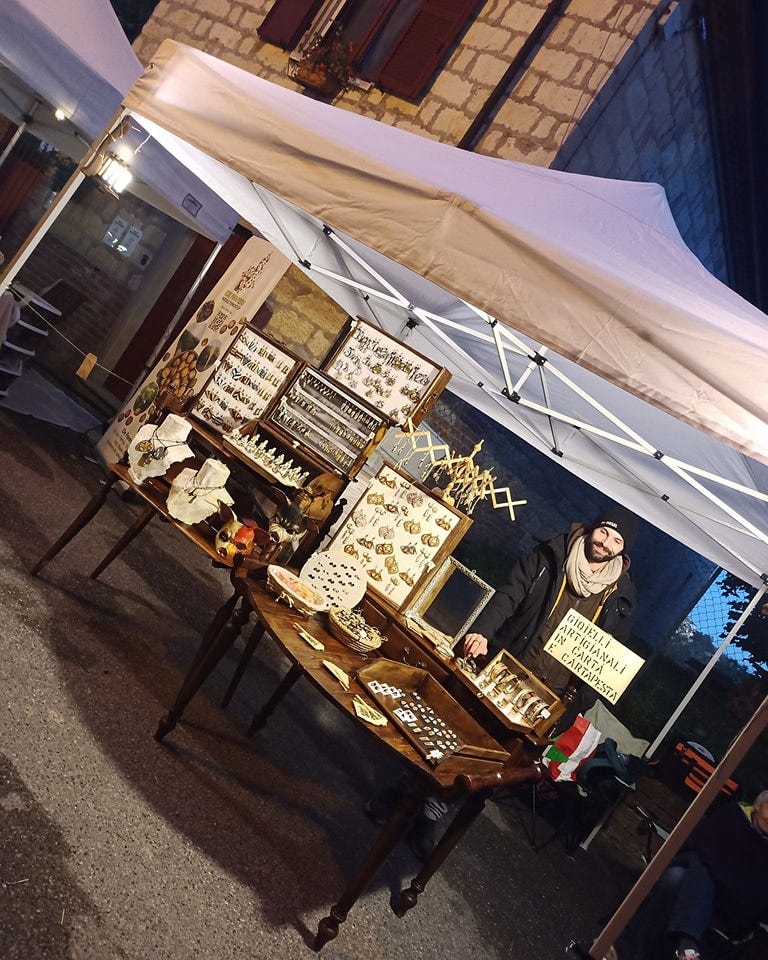
At the very first market I ever attended, I started with the classic setup every hobbyist knows. I borrowed folding tables and a pop-up gazebo, built a few small display stands, packed everything into cardboard boxes, and prepared plenty of decorative elements. By the end of that first day, I realized that space simply didn't represent who I was. Coming from a background in theater, the whole setup felt slow, cumbersome, and uninspiring. I couldn't imagine myself looking at it and saying, "Yes, I could do this every single day."
I became fascinated by the idea of pouring my experience as a set designer into that little 3-by-3-meter square. So I decided to build a display table that resembled a stage, surrounded by modular furniture that could be assembled and taken apart with ease. I wanted to create my own little theater, piecing it together from antique and reclaimed objects I could find along the way.
 |
Back then, I only took part in a handful of small local markets. I didn't feel my designs had reached a point where they truly represented me—I was still experimenting—so for the occasional appearance, that setup worked well enough.
That was until the day I witnessed the brilliant farming strategy of the leek seller.
It was the end of the day at a truffle fair. Everyone was stuck in a long, straight street, waiting for the chance to pack up and leave. Luckily, our stall was the last in the row, so we were also the first allowed to dismantle. As we were packing, the assistants from the farmer selling leeks walked past us, carrying the day's empty crates on two small handcarts. In just two trips, everything was gone. They finished before we did and slipped away through the side streets.
Having already endured another exhausting teardown at a previous event—fighting my way through the traffic of dismantling stalls while carrying a gazebo on my shoulder just to get out as quickly as possible—I was struck by a simple idea:
What if the stall itself had wheels?
I wondered, what if we were the ones leaving in fifteen minutes, weaving through the crowd with that quietly satisfied grin?
Partly out of pride, partly out of sheer stubbornness, I started designing. I imagined the simplest and most affordable solution: a structure that could be dismantled to fit inside a car, yet be light enough to move easily through the streets of Turin, where I'd always been reluctant to attend markets because of the logistics.
The more I designed, the more I realized—thanks to experience—just how unnecessary many of the conveniences we take for granted actually were.
A gazebo? Useless. If it starts raining, expecting customers is already optimistic.
A three-meter-wide stall? Too much to manage with only two eyes. Human vision comfortably covers about two meters. People only notice a few things at a time—some look up, others look down—so two display levels at different heights made far more sense.
Boxes that already contained everything would eliminate the need to carry extra weight.
Anything bulky had to go.
The fastest and cheapest way to cover medium distances? A bicycle—the one I was already using to get around Turin. The solution had been there all along. No parking. No restricted traffic zones. Complete freedom.
When I told my family I wanted to ride around Turin pulling a trailer behind my bicycle, they thought I was joking. It went against the usual idea of growth. Instead of adding, expanding, and accumulating, I wanted to remove. What everyone else saw as conveniences, I saw as unnecessary burdens that created constant dependence.
The only person who took me seriously was my mother. She knew how stubborn I could be. She also knew that every time I went out, she'd worry about seeing me on the front page of the newspaper after being hit by a car.
To me, this wasn't just another way of attending markets—it was a genuine way to launch the project. Lower startup costs meant greater flexibility and better pricing. More importantly, it allowed me to showcase my skills immediately, not only through the products I made, but through the way I presented them.
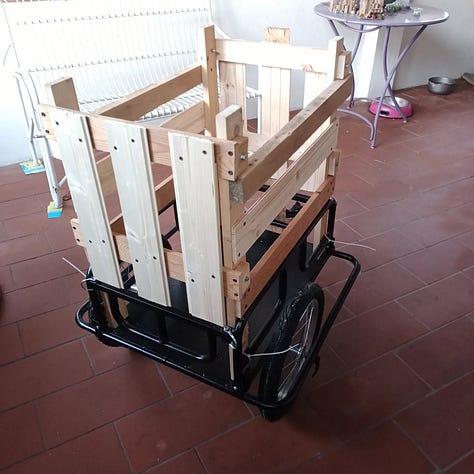
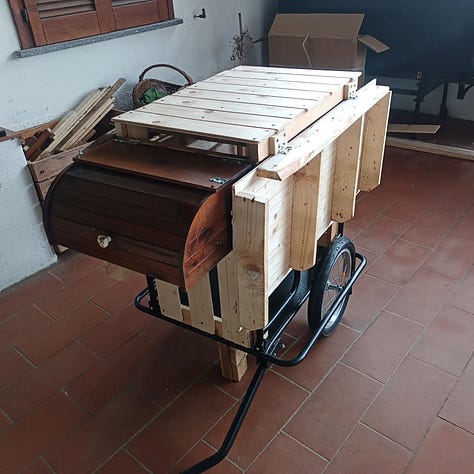
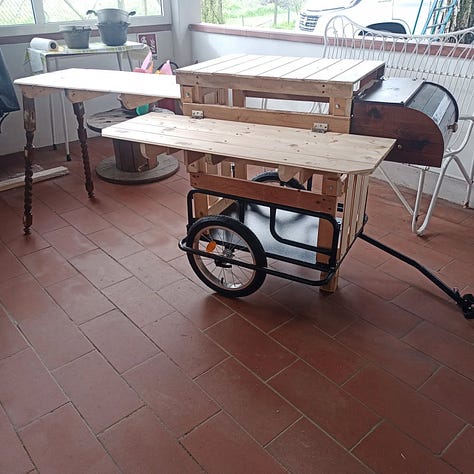
The plan was to build everything from reclaimed materials, just as I had done with other pieces of furniture. I bought myself a bicycle trailer and started building what would eventually become Priscilla.
I began cutting apart old wooden pallets and quickly discovered the reality of small-scale craftsmanship: on projects like this, you constantly have to invent new solutions, figuring out how different parts can fit together so they can be assembled from either side during setup.
 |
 |
 |
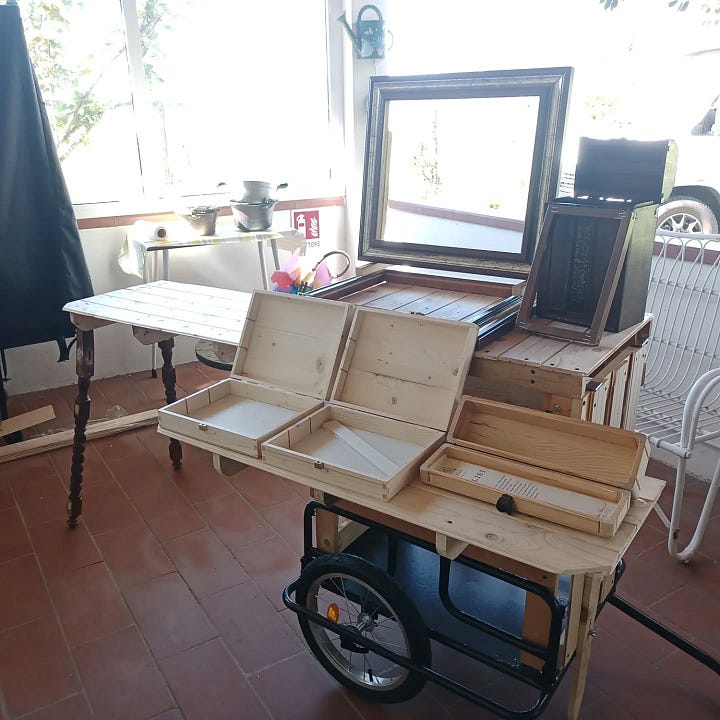 |


It took me months to build, tackling the project one stage at a time. I carefully designed the storage boxes so they would fit inside the frame with millimeter precision. I rescued an old bread box, which became my packaging cabinet, and dismantled an antique chair to turn its legs into the supports for the side display table, reusing parts from my previous stall. I painted the entire structure in my basement to give it character, hoping it would grow even more beautiful over time as the paint naturally wore away.
As I worked, I began noticing flaws I hadn't considered at the start. Much of the process was improvised. I added braces to make the structure more stable and prevent accidental contact with the wheels. I built a small access door so I could reach my backpack, since the only opening had originally been through the main storage compartment. Even today, every couple of months, I give Priscilla a full check-up. I tighten, adjust, improve what needs improving, and remove whatever has become unnecessary.
It is the most enjoyable and rewarding project I have ever built.
I still remember the fear of those first days, taking Priscilla out onto the streets, with Eleonora cycling behind me to make sure nothing was falling apart. Every pothole and every creak triggered a small panic attack, made even worse by that familiar feeling of embarrassment that comes with doing something unconventional.
Priscilla was meant to prove something—not to anyone else, but to myself. We spend so much time convincing ourselves that everything is too complicated, impossible, that we always need more before we can begin. I chose the opposite approach. I chose to remove instead of add.
Sometimes all it takes is a little ingenuity and the willingness to move in the opposite direction—to take a step back and think as though you had nothing at all. That's often where you'll find the simplest, most effective solution, the one that truly fits your needs.
Final Thoughts
Ironically, Priscilla, my traveling boutique, is appreciated far more by fellow artisans than by customers. Every time they see me arrive, they fall in love with the idea. They admire how quickly it can be set up and packed away, envy its low operating costs, and immediately recognize how versatile it is. They fall for it—just as I did while I was building it.
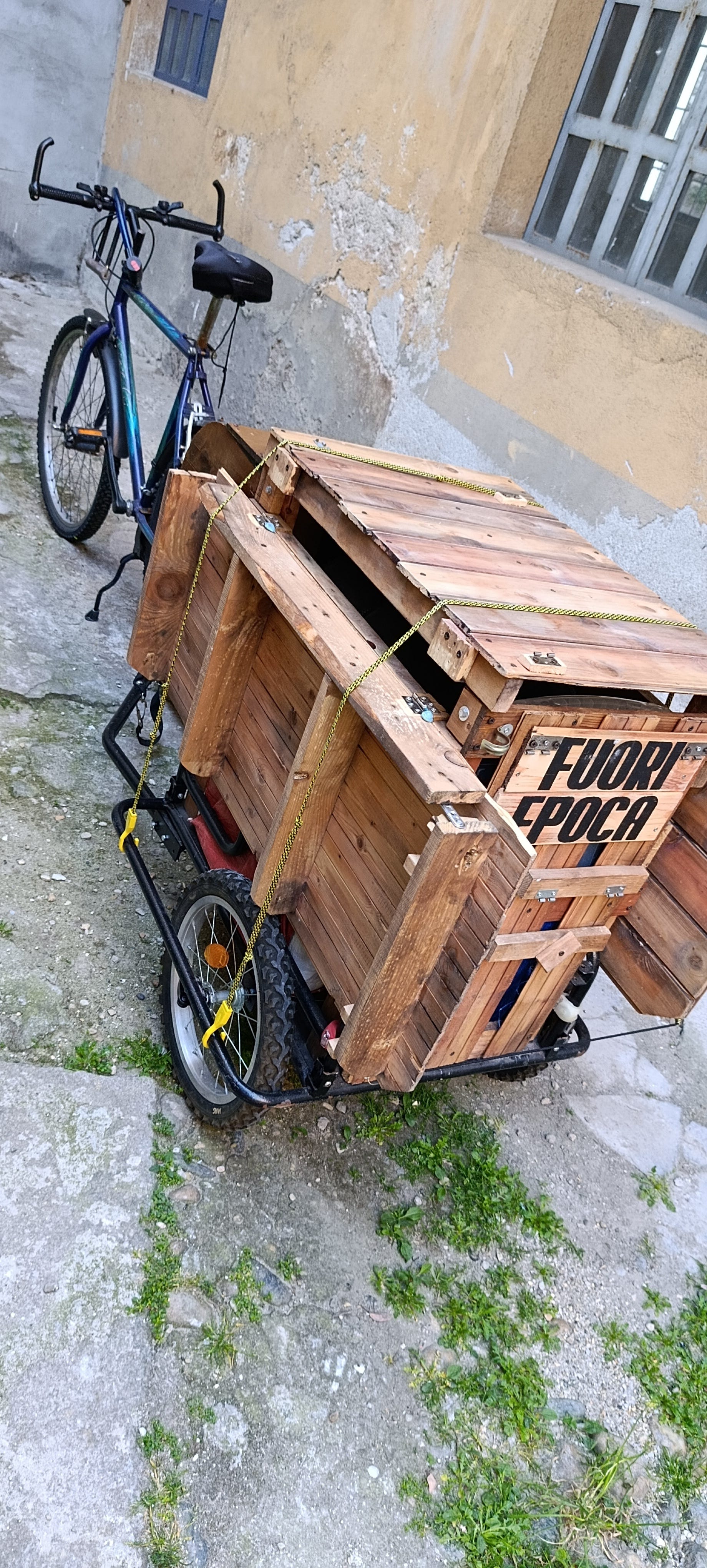
She's a little temperamental at times, especially on the road. If even one item isn't packed properly, I can't close the lid. She sways from side to side while we're riding, and I've never been brave enough to take both hands off the handlebars for fear of tipping over. She can be stubborn around corners too—you have to take them slowly. It's always better to keep both wheels firmly on the ground than watch her balancing on one like she's trying to drift. And if there's a hill, you'll make it home completely exhausted. On the bright side, you can save yourself a gym membership—she'll make sure you get your workout every weekend.
Once we stop, though, she transforms. She opens up into a beautiful little market stall: bright, compact, stable, and surprisingly gentle. That's where the contradiction lies. Very few people who pass by truly understand what she is or the role she plays. Most see nothing more than a table with legs. In a way, she remains in the background. People naturally focus on what she carries rather than on her, even though she is, in many ways, the soul of my entire project.
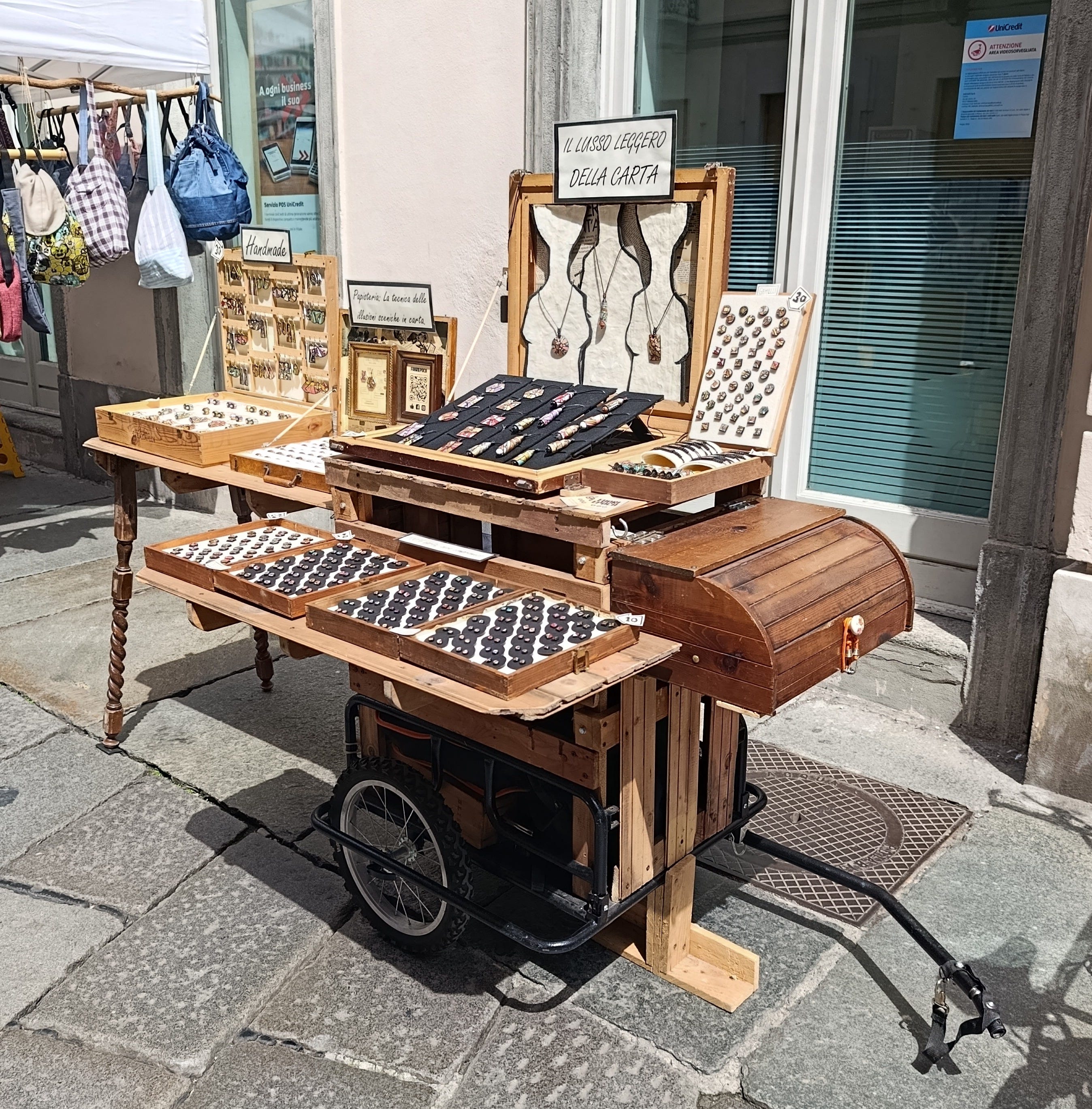
She was conceived as an eco-friendly, experimental solution with a vintage aesthetic. Her purpose was to draw you into the experience, to quietly tell you: everything here is handmade. It's strange how something so carefully designed can become almost invisible once it's out on the street.
I genuinely believed that people would see me cycling past, notice the large FUORIEPOCA sign, become curious, film it, and then look me up on Instagram. At first, I even used the hashtag #manwiththecart to make myself easier to find. But nothing happened. Maybe I've simply never figured out how to recreate, in the real world, the kind of attention that comes so easily online.
Who knows? Perhaps one day, after seeing me around often enough—and helped by a little word of mouth—even the most distracted passerby will come to appreciate her the way I do.
I like to imagine a future where, driven by rising fuel prices, every artisan travels with a vehicle of their own invention: wheeled trunks, handcrafted cargo carts, sporty cargo bikes. Each one with its own extraordinary Priscilla.
More than a journey through memories, this is an introduction to Priscilla—and an invitation to look at design, craftsmanship, and problem-solving from a different perspective.
I hope you enjoyed the article. If you'd like to follow the journey, you can subscribe to my Substack newsletter by leaving your email address and stay up to date with future stories and projects.
- Stefano
This article has been translated using an automated translation system.

Commenti
Posta un commento